
You've mapped out your solar array, calculated your daily watt-hours, and landed on a panel configuration you're happy with — then you realize the battery bank is the decision that actually defines whether your system works when you need it most. Pick wrong and you're back at the hardware store in two years. In 2026, the solar deep cycle battery market spans three chemistry types and a fivefold price range, making it genuinely difficult to separate a great value from a marketing-dressed disappointment.
Deep cycle batteries discharge slowly to 50–80% of their capacity and recharge repeatedly over hundreds or thousands of cycles — fundamentally different from the short-burst chemistry of a car starter battery. Sizing your bank correctly depends on understanding charge rates as much as raw capacity. Our guide on how long it takes to charge a 12V battery with a solar panel walks through the math you need. For all solar and clean energy applications, the right battery chemistry locks in your return on investment for the next decade — or quietly undermines it.
We evaluated seven deep cycle batteries that deliver real value across AGM and lithium iron phosphate chemistries, from proven workhorses under $200 to premium 200Ah lithium packs built for serious off-grid systems. Every pick below was selected on verified capacity ratings, cycle life data, build quality, and documented real-world performance from thousands of solar installations.
Contents
Not every solar battery fits every system. The standouts below represent the best balance of price, performance, and longevity across the AGM and lithium categories. The short answer: go lithium if you're building a system meant to run for a decade; go AGM if budget is the constraint and you're comfortable with the chemistry trade-offs.



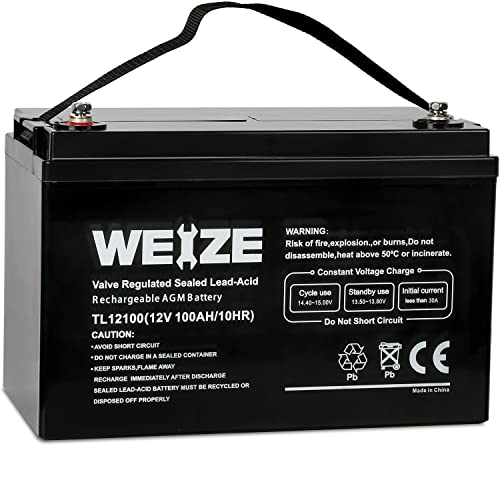


Interstate Batteries has been producing professional-grade SLA batteries for decades, and the SLA1185 is their deep cycle flagship for solar applications. This Group 27 battery delivers a verified 100Ah capacity at 12V using AGM construction paired with Valve Regulated Lead Acid (VRLA) technology. The sealed design means zero maintenance, zero spills, and zero off-gassing — you can mount it in any orientation and install it in enclosed compartments without ventilation concerns.
What separates this from cheaper AGM alternatives is manufacturing consistency. Interstate's plate-to-terminal connections are tighter than budget equivalents, which reduces internal resistance and improves charge acceptance from your solar controller. The Flag terminal design handles high-current connections more securely than standard post terminals, though you'll want to verify your battery cable connectors are compatible before ordering. The battery is approved for all transport modes including air freight, which matters for remote installations, and carries a 12-month performance warranty.
For solar systems powering LED lighting, a small inverter, or a cabin's basic loads, the SLA1185 delivers rock-solid baseline performance at an honest price. You won't get lithium's cycle count or weight savings, but you get a battery from a brand with real accountability and a track record you can verify. If your budget tops out at AGM and you want a name you can trust, Interstate earns this spot.
Pros:
Cons:
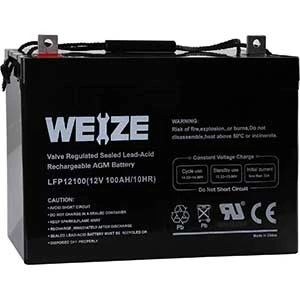
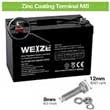
Weize has built a strong reputation in the value AGM segment, and their 12V 100Ah deep cycle battery is a consistent bestseller for good reason. The specs are honest: genuine 100Ah capacity, a verified 1150A max discharge current (1100A sustained for 5 seconds), and a self-discharge rate of just 1–3% per month at room temperature. That low self-discharge rate is a real advantage — you can store this battery for months without sulfation damage, unlike cheaper AGMs that lose significant charge within weeks.
The operating temperature window is wider than most budget competitors: charging accepts down to 14°F (−10°C), discharging remains functional to 5°F (−15°C). In practice that means the Weize keeps performing through genuine northern winters where cheaper AGMs refuse to accept a charge. Dimensions sit at 12.99" × 6.73" × 8.43", with color-coded terminals in standard convention — positive left, negative right. Like all lead-acid batteries, expect a capacity reduction below the optimal 77°F operating point.
For RV house batteries, solar backup, trolling motor power, and marine applications, the Weize delivers more value per dollar than most brand-name alternatives. You trade some cycle life versus lithium, but at roughly a third of the price you can afford to replace it twice and still come out ahead over five years. If AGM is your chemistry and budget matters, this is your battery in 2026.
Pros:
Cons:
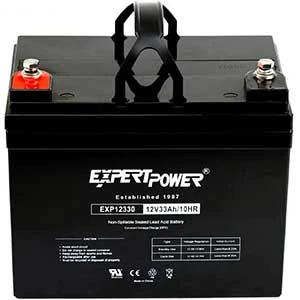
ExpertPower brings 36 years of battery manufacturing experience to their LiFePO4 lineup, and the 12V 100Ah Bluetooth model is the standout in their catalogue. This uses Grade A+ prismatic cells — larger, safer, and more thermally efficient than the cylindrical cells found in lower-cost lithium packs. The 4,000–7,000 cycle rating with a 10-year expected lifespan is the financial case for going lithium in one number: over that lifespan you'll replace an AGM battery four to six times to match it, negating the price gap entirely.
The built-in BMS covers six protection modes: overcharge, deep discharge, overloading, overheating, low-temperature damage, and short circuits. The Bluetooth integration earns its keep in daily use — you check state of charge, individual cell voltages, and BMS status from the ExpertPower app without touching the battery. The system scales to 4 batteries in series for a 48V / 100Ah configuration, or up to 10 in parallel for a 12V / 1000Ah bank. For serious off-grid solar builds, that expandability means you can start with one battery and scale the bank as budget allows.
Weight savings are substantial. At roughly 26 lbs versus 65+ lbs for a comparable AGM, installations are lighter and easier to reconfigure. The ExpertPower 100Ah LiFePO4 is the pick for anyone building a system they intend to run hard for the next decade without replacing the battery bank every other year.
Pros:
Cons:
When 100Ah isn't enough and you want to avoid wiring multiple batteries in parallel, LOSSIGY's 200Ah LiFePO4 delivers 2560Wh of usable energy in a single unit. That's roughly what two 100Ah AGMs provide — but in one battery, at half the combined weight, with no inter-battery balancing issues to manage. Auto-grade A cells with a 5,000+ deep cycle rating and a 10-year lifespan make the math on the premium price straightforward when you run it against a decade of AGM replacements.
The integrated BMS covers the full protection matrix: overtemperature, undertemperature, short circuit, over-current, and overload. Installation is simpler than series-wiring multiple smaller lead-acid batteries for equivalent capacity — one battery, standard terminals, done. For RVers who've been managing four flooded 6V batteries with a monthly watering schedule, this is a clean, permanent upgrade that eliminates the chemistry headaches. At 80% depth of discharge — which LiFePO4 handles without cycle penalty — you're drawing 160Ah of reliable energy every cycle.
Pair the LOSSIGY 200Ah with a quality MPPT charge controller and a well-sized solar array, and you have a serious off-grid foundation. It's the pick for RV full-timers, boat liveaboards, and remote cabin setups that need genuine storage depth without the complexity of a multi-battery bank. The only notable gap versus the ExpertPower model is the absence of built-in Bluetooth monitoring — you'll need a separate battery monitor to watch state of charge.
Pros:
Cons:
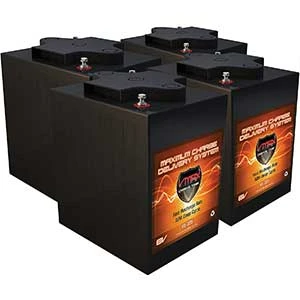
Trojan Battery Company has manufactured deep cycle batteries since 1925, and the T-105 remains the gold standard in flooded lead-acid solar storage. This set of four 6V / 225Ah GC2 batteries gives you a 24V / 225Ah bank wired in series, or a 12V / 450Ah bank in two series-parallel pairs — more proven, serviceable capacity than any comparably priced alternative. Solar professionals and off-grid homesteaders have relied on the T-105 for decades because it delivers on its ratings consistently.
Flooded batteries require maintenance — check and top off electrolyte every 1–3 months with distilled water, and they need proper venting in any enclosed installation. That's a real operational commitment. What you get in return is the lowest upfront cost per amp-hour of any chemistry, and the ability to directly inspect and service the cells. When a flooded battery starts underperforming, you can diagnose it with a hydrometer and respond accordingly. For a detailed look at how Trojan stacks up against the other main flooded competitor, our Crown vs. Trojan battery comparison covers exactly where each brand wins.
The GC2 form factor is the industry standard for golf cart and solar deep cycle applications — battery boxes, racks, and cable sets are universally available for this size. These are working batteries for serious solar installations with dedicated battery rooms. High weight (approximately 62 lbs each) and mandatory venting make them impractical for RVs or sealed compartments, but for a fixed off-grid system where you control the environment, the Trojan T-105 is still unbeaten on cost-per-cycle at scale.
Pros:
Cons:
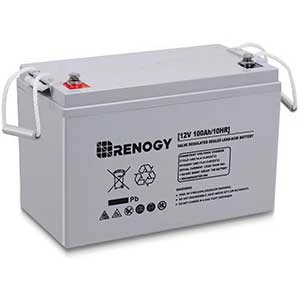
Litime's Group 24 LiFePO4 battery solves the problem most upgraders face: you want lithium performance in the same physical space your AGM currently occupies. Group 24 is the most widely standardized battery size in RV, marine, and solar applications, and Litime engineered this battery specifically to drop into existing boxes and brackets without modification. At 21.9 lbs — 63% lighter than a comparable AGM — your installation gets measurably easier to handle and reconfigure.
The Bluetooth 5.0 integration with the LiTime app provides real-time monitoring of state of charge, cell voltages, temperature, and BMS status from your phone. The upgraded smart BMS covers over-charge, over-discharge, over-current, and short circuit protection. Critically, it includes a low-temperature cut-off that prevents charging below freezing — a common failure mode in cheaper lithium batteries where sub-zero charging fractures cells and voids warranties. The 15,000-cycle maximum rating is at shallow depth of discharge; at a more aggressive 80% DoD you're looking at 4,000+ usable cycles with a 10-year lifespan.
For solar-charged trolling motor setups and off-grid marine applications, the combination of precise state-of-charge monitoring and lightweight construction is genuinely valuable. Our guide on the best solar chargers for trolling motor batteries pairs directly with this chemistry — know exactly how much charge you're putting in and what's left before you're stranded on the water. If you're upgrading from AGM without rewiring anything, this is your cleanest path forward.
Pros:
Cons:
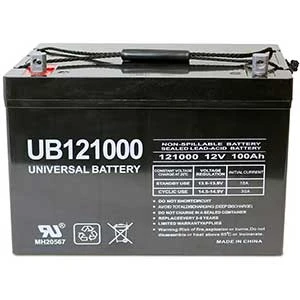
NPP's NP12-100Ah stands out in the AGM category for a specification most competitors quietly omit: a 12-year design life in float service at 25°C. For standby solar backup — grid-tied systems with battery backup for outages, emergency lighting, UPS installations — float service life is the number that determines your total cost of ownership, not cycle count. This battery is engineered precisely for that role.
The construction is standard sealed AGM: 100% maintenance-free, leak-proof, no electrolyte to manage. The Group 27 compatible dimensions (12.99" × 6.73" × 8.43", terminal height 8.66") fit the most common battery enclosures and racks for a direct drop-in replacement. For security systems, solar-powered emergency lighting, UPS units, and grid-tied residential backup where the battery spends most of its life at full charge and only discharges during outages, the NPP's 12-year float life engineering genuinely extends replacement intervals beyond what cheaper AGMs can deliver.
This isn't a daily-cycling off-grid battery, and it doesn't pretend to be. It's a standby backup battery with exceptional longevity in its specific application. For grid-tied solar homeowners who need battery backup as insurance rather than primary storage, the NPP NP12-100Ah offers the lowest total cost of ownership in the standby AGM segment for 2026.
Pros:
Cons:
Chemistry determines almost everything about your battery's performance, maintenance demands, and long-term value. In 2026, four chemistry types cover the solar storage market, and each makes economic sense in specific applications.
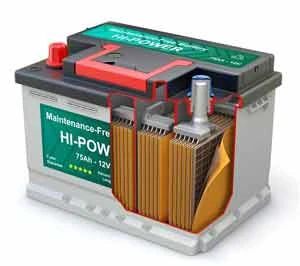
Flooded lead-acid batteries like the Trojan T-105 need regular electrolyte top-ups and mandatory venting, but deliver the lowest upfront cost per amp-hour of any chemistry. They're the right choice for fixed off-grid homesteads with a dedicated battery room and a hands-on owner. According to the Wikipedia overview of deep-cycle batteries, flooded lead-acid remains one of the most proven technologies for high-capacity solar storage despite being over a century old.
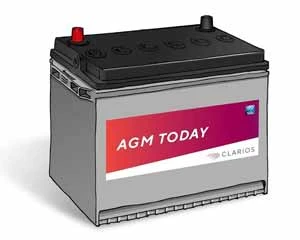
AGM (Absorbent Glass Mat) batteries seal the electrolyte in fiberglass matting, eliminating spills and off-gassing. You get performance close to flooded with zero maintenance and full mounting flexibility. They cost more than flooded but substantially less than lithium. For RVs, boats, and any installation where you can't inspect electrolyte levels regularly, AGM is the practical sealed choice.
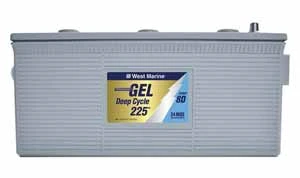
Gel batteries suspend the electrolyte in silica gel, making them the most vibration-resistant and temperature-stable lead-acid option. They tolerate partial state of charge better than AGM — an advantage for solar systems with inconsistent charging days. The critical caveat: gel batteries require precise charge voltage settings. Overcharging permanently damages the gel matrix, which is why your solar charge controller must have a correct gel profile configured before you connect one.
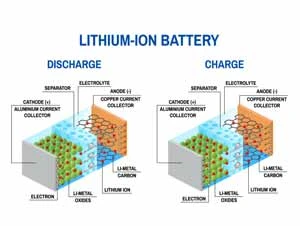
Lithium iron phosphate (LiFePO4) is the dominant chemistry for premium solar storage in 2026. The cycle life advantage — 2,000–10,000+ cycles versus 300–500 for AGM — is the decisive long-term financial argument. Add 50–70% weight savings, 80% usable capacity versus 50% for lead-acid, and integrated BMS protection covering every failure mode, and the case for lithium becomes clear for anyone building a system they intend to run for a decade.
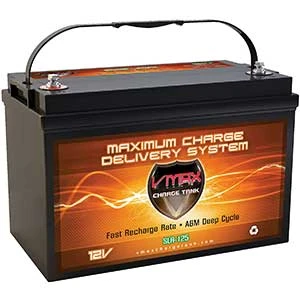
Capacity is rated in amp-hours at the 20-hour discharge rate (C20). A 100Ah battery discharged over 20 hours delivers 5 amps continuously — draw it faster and effective capacity drops. For daily solar cycling, size your bank to cover 2–3 days of autonomy at 50% depth of discharge for lead-acid, or 80% DoD for lithium. Most off-grid cabins and RVs need 200–400Ah minimum; whole-home systems run 600Ah or more.
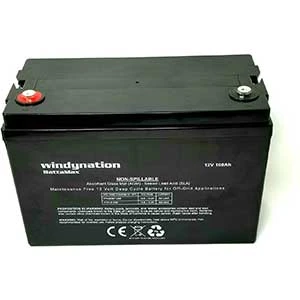
System voltage — 12V, 24V, or 48V — shapes your wiring and efficiency. Higher voltage systems carry the same power through thinner wire with less resistive loss, reducing copper costs significantly on longer cable runs. RV and small cabin systems typically run 12V. Larger off-grid homes and bigger solar arrays benefit from 24V or 48V architectures. Wire batteries in series to increase voltage; in parallel to increase amp-hour capacity. Never mix batteries of different ages, chemistries, or capacities in the same bank — the imbalance damages both.
Cycle life counts complete charge/discharge cycles before capacity drops below 80% of rated. That number is always quoted at a specific depth of discharge. Regularly discharging an AGM below 50% will cut its cycle count dramatically — sometimes by more than half. LiFePO4 tolerates 80–100% DoD with far less penalty, which is why the effective amp-hours you can actually use from a lithium battery are nearly double a same-rated lead-acid at equivalent cycle life.
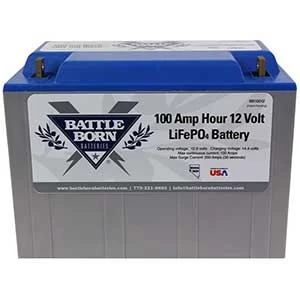
Calculate your true 10-year battery cost by dividing total system cost — including replacements — by total usable watt-hours delivered over the lifespan. Lithium frequently wins this calculation by a 2:1 margin over AGM when systems run daily deep cycles. For standby backup systems that rarely discharge deeply, AGM's lower upfront cost wins outright.


Temperature affects performance more than most buyers account for. Lead-acid batteries lose 10–15% capacity for every 15°F drop below 77°F optimal. Lithium BMS systems cut off charging at 32°F to prevent cell damage — a safety feature that requires planning in cold climates. Look for published charge and discharge temperature ranges, not just an operating temperature spec. The charge range matters; some batteries that claim cold-weather operation only discharge in the cold — they won't accept a charge until they warm up.
Warranty terms reveal manufacturer confidence. A 1-year warranty on an AGM versus a 10-year warranty on a LiFePO4 directly reflects expected cycle life. Check whether the warranty covers capacity fade or only manufacturing defects. For any battery over $300, read the actual warranty document before committing — pro-rated warranties that cover only 20% of replacement cost by year 3 are common and easy to miss in the product listing.
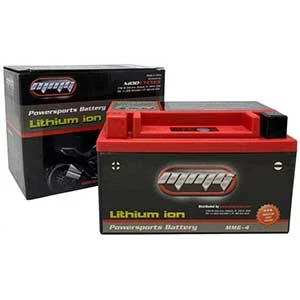
Verify the lithium chemistry before you buy. Consumer lithium-ion batteries in power tools and powersports vehicles use cobalt-oxide chemistry that is not suitable for deep cycle solar storage — thermal runaway risk, shorter cycle life, and no BMS sized for prolonged deep discharge. You want specifically lithium iron phosphate (LiFePO4): thermally stable, cycle-optimized, and safe for stationary indoor installation without active cooling or climate control.
A car starter battery delivers a massive short burst of current to crank an engine, then immediately recharges from the alternator. It's designed to stay near full charge and never discharge deeply — doing so kills it quickly. A deep cycle battery is built from the ground up to discharge slowly to 50–80% of its capacity and recharge repeatedly over hundreds or thousands of cycles. The plate design, chemistry, and construction are fundamentally different. Using a car battery for solar storage will destroy it within weeks of regular cycling.
Start with your daily energy consumption in watt-hours: add up the wattage of each device multiplied by its hours of daily use. Divide by your system voltage (12V, 24V, or 48V) to get amp-hours per day. Multiply by your days of autonomy (typically 2–3 days without meaningful solar input). Then divide by 0.5 for lead-acid (50% DoD limit) or 0.8 for lithium (80% DoD). A basic off-grid cabin running lights, a small refrigerator, and phone charging typically needs 200–400Ah at 12V.
No. Different chemistries require different charge voltages, have different self-discharge rates, and carry different internal resistance characteristics. Connecting them in parallel causes one chemistry to overcharge while the other undercharges, degrading both simultaneously. The same problem occurs when mixing batteries of the same chemistry but different ages or capacities. Build your bank with identical batteries from the same production batch — it's the only way to guarantee balanced charging and loading across the bank.
Yes. Lead-acid variants — flooded, AGM, and gel — each have distinct charge voltage profiles, and gel in particular is permanently damaged by AGM charge settings. LiFePO4 batteries require a charger or solar charge controller with a dedicated LiFePO4 profile (typically 14.4–14.6V absorption, no equalization stage). Most quality MPPT solar charge controllers offer selectable battery chemistry profiles. Never use a basic automotive float charger or a standard starter battery charger on any deep cycle solar battery.
Lifespan depends on depth of discharge and daily cycle frequency. An AGM battery discharged to 50% daily delivers roughly 300–500 cycles — approximately one to two years of daily use before capacity degrades significantly. A LiFePO4 battery discharged to 80% daily delivers 2,000–7,000 cycles — five to twenty years of daily use depending on brand and cell quality. Any battery operated at shallower discharge and moderate temperatures lasts considerably longer. Avoiding full discharge on lead-acid batteries is the single most effective way to extend their lifespan.
LiFePO4 is the safest lithium chemistry available for stationary indoor storage. Unlike cobalt-based lithium-ion batteries used in consumer electronics and power tools, LiFePO4 does not undergo thermal runaway under normal operating or overcharge conditions, doesn't off-gas during charging, and doesn't require active cooling or climate control. A quality built-in BMS adds protection against overcharge and short circuits on top of the chemistry's inherent stability. It's the standard chemistry for residential battery storage systems, RVs, and marine applications — with an excellent safety record across millions of installations.
The battery you buy today sets the ceiling on your solar system's reliability for the next decade — choose chemistry first, brand second, and price last.


About Malcolm Woods
Malcolm Woods is a technology writer and sustainability advocate with a background in consumer electronics and a long-standing interest in the intersection of technology and environmental impact. He has spent years evaluating tech products — from smartphones and smart home devices to solar-powered accessories — with a focus on real-world performance, longevity, and value. At the site, he covers tech accessory reviews, smart home gear, buying guides, and practical how-to content for everyday technology users.
Go for the FREE Gifts. Or check out for free energy books from our best collection.
Remove Ad block to reveal all the secrets. Once done, hit a button below